PAI OS
$59.00
PAI OS is the PAI software as an image you install on your own x86 mini PC. It is the same software that will ship on PAI boxes, so you get the full assistant without buying our hardware.
It is for people who already own a capable mini PC, or want to choose their own, and are comfortable installing an operating system image. You need an x86-64 computer with 16 GB of memory or more. With 16 GB, plan for 7-14B models and gpt-oss-20b. With 32 GB, plan for 20-30B mixture-of-experts models. More memory means bigger models.
On first boot PAI interviews you for about 15 minutes. Then it writes a plain-English page of what it will and will not do. You can read it and edit it.
You talk to PAI in the PAI app, an installable web app that only your own devices reach over your private network. Signal and Matrix, both end-to-end encrypted, are planned for month 1. Telegram and email work at launch, with a catch: Telegram relays bot chats on its servers and is not end-to-end encrypted, and your mail provider carries your email. WhatsApp and iMessage are optional and unsupported. Inference is local. If you choose WhatsApp or iMessage, Meta or Apple still carry the message.
No PAI account holds your data, and telemetry is off by default. Your personal memory and the search index over your own files live in a SQLite file on the box. Remote access goes through a private overlay network, so nothing listens on public interfaces.
PAI OS includes one year of updates. After that, PAI Care keeps the updates and new model packs coming. If you later move to a PAI box, the software is the same.
We have not measured speed, power or noise yet. We will publish measured numbers for each model and each upgrade stage after prototype testing. Which models fit on which memory size is an estimate until then.
Sovereign AI Interfaces
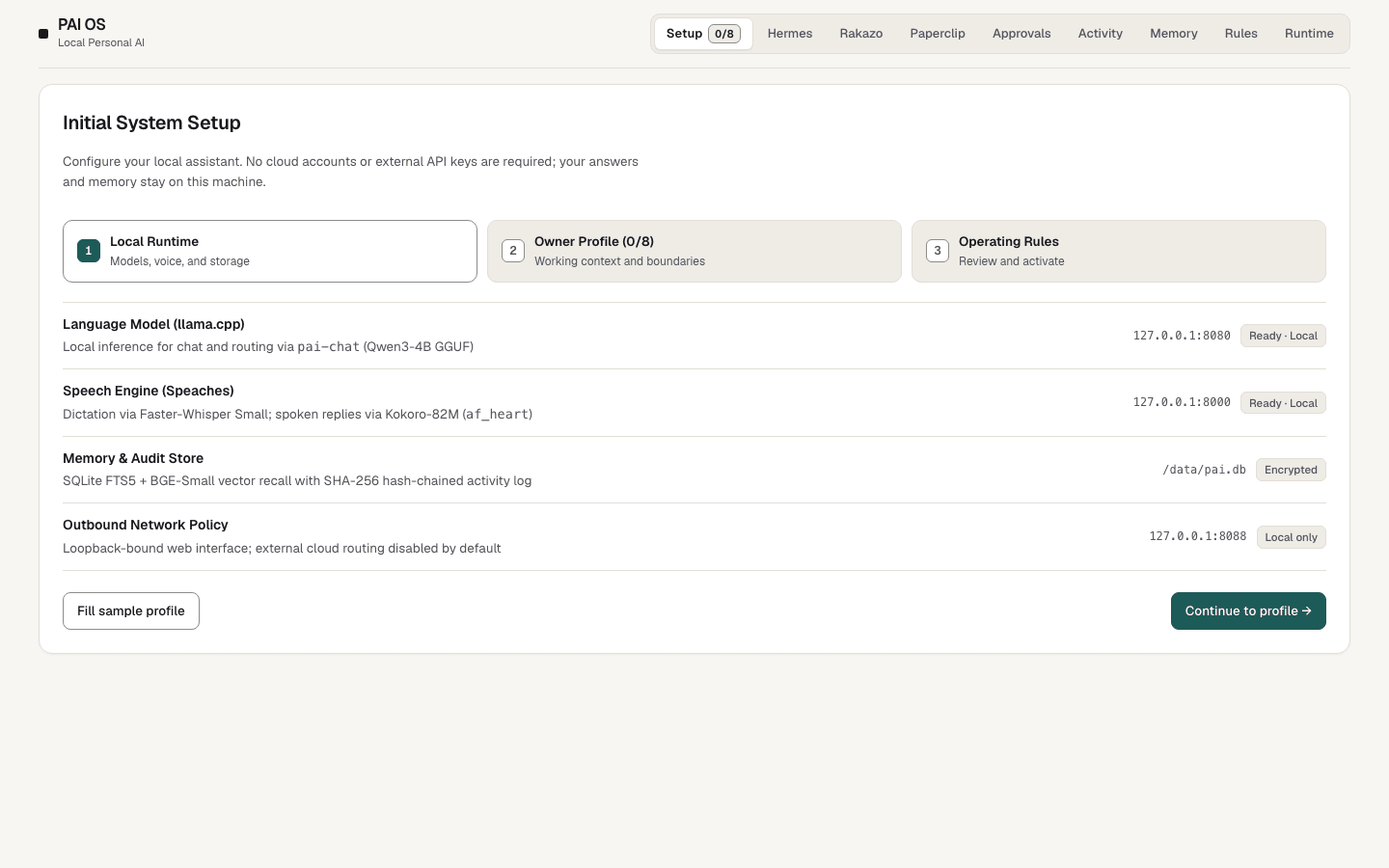
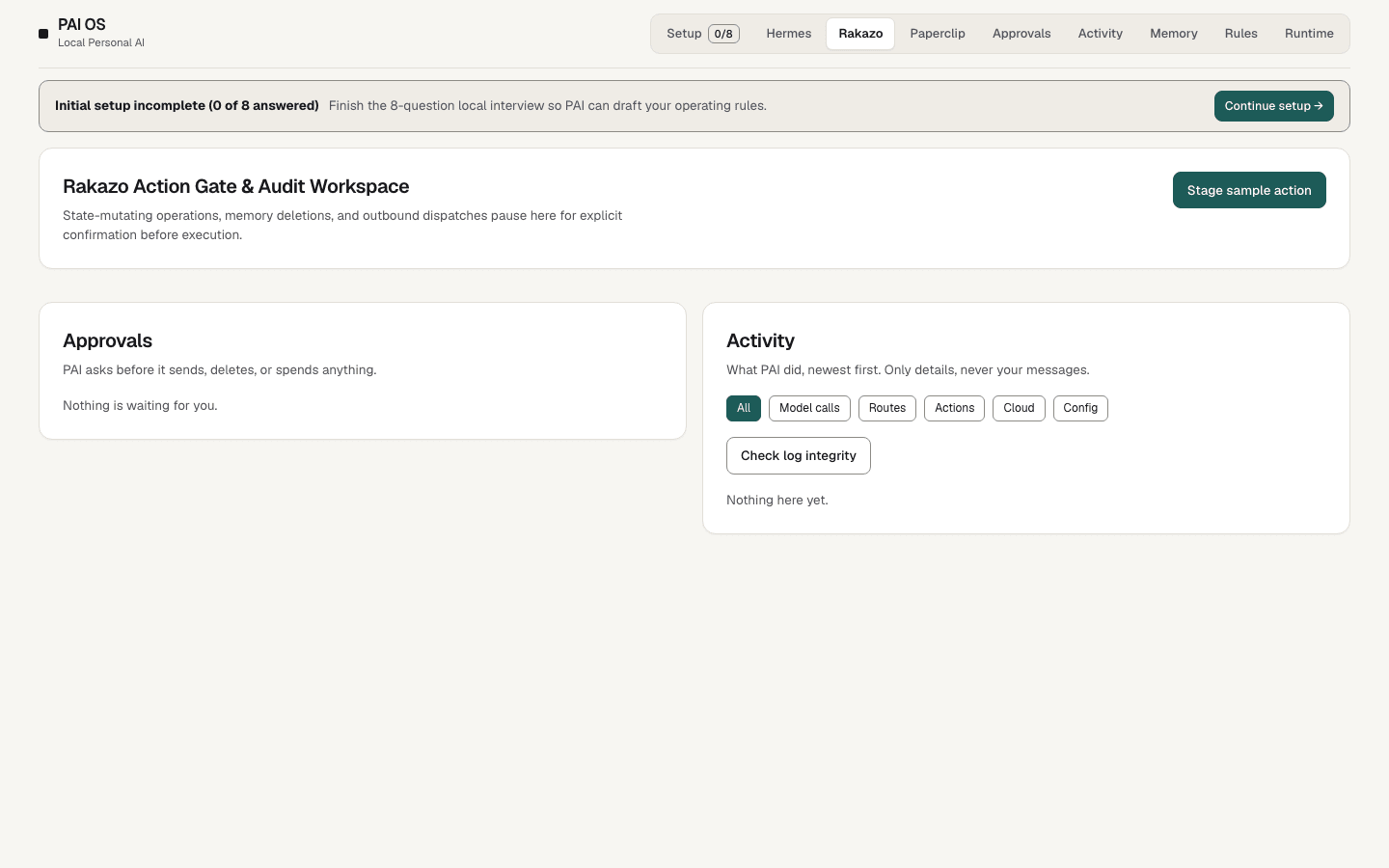
PAI OS boots into native sovereign interfaces: Hermes UI for natural voice, chat, and memory exploration, First-Boot Setup for local onboarding, and Rakazo UI for autonomous browser automation.
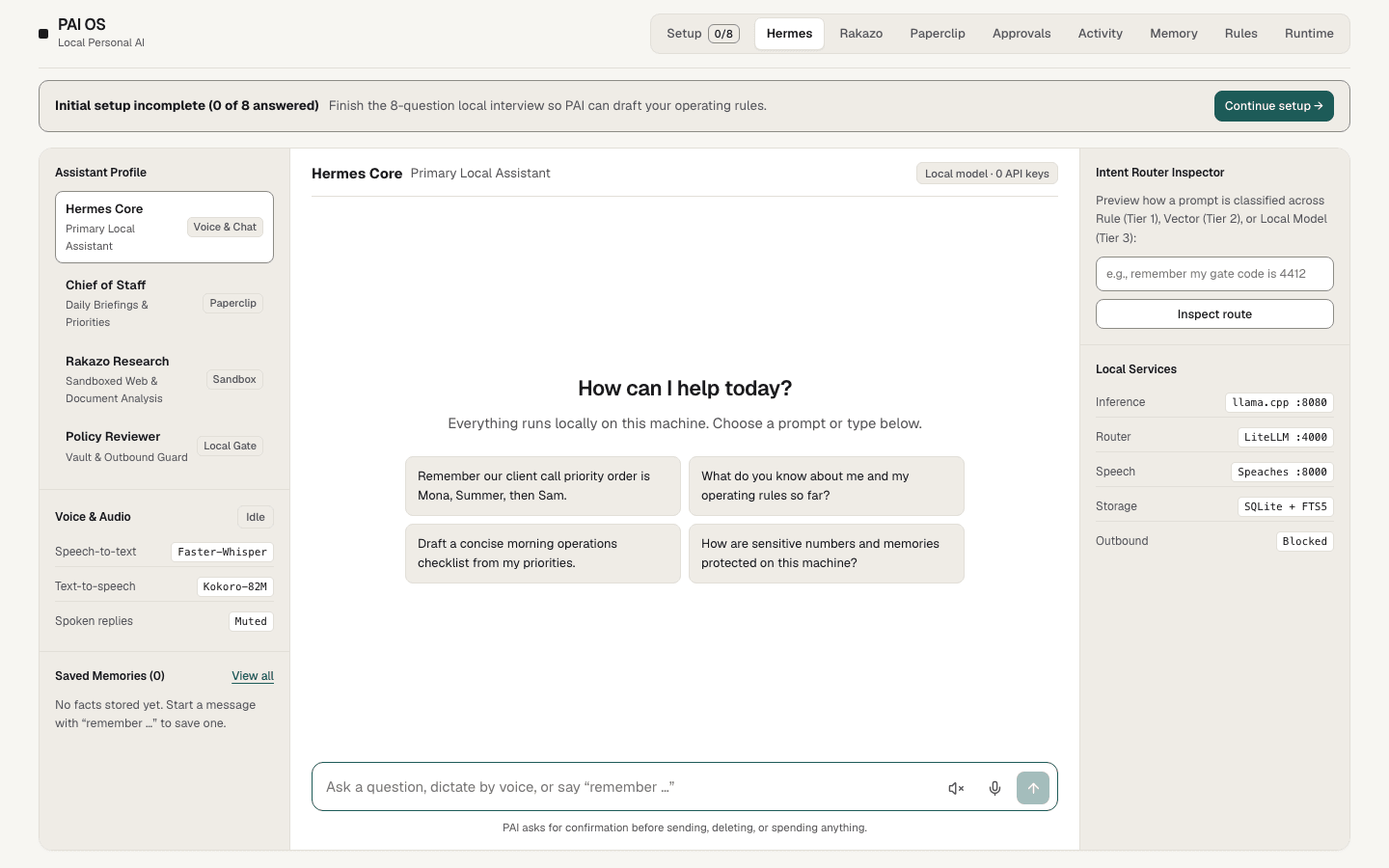
Streaming Silero VAD turn detection with instant barge-in interruption. Natural voice-to-voice conversation.
Single-file deterministic vector index. Search conversations, notes, and local documents with zero cloud sync.
Real-time token speed counter, unified memory allocation gauges, and temperature monitoring on bare metal.
Sub-500ms Real-Time Voice Architecture
Built on the LiveKit Agents SDK and WebRTC real-time media transport. Engineered for sub-500ms conversational turn-taking with instant barge-in interruption and offline local fallback.
VAD & Ingest
Silero VAD runs client-side frame-by-frame with WebRTC echo cancellation and adaptive noise reduction.
Streaming STT
Zero-latency streaming transcription. Local Whisper or Deepgram streaming emits partials every 80ms.
Local TTFT
llama.cpp and Ollama stream first token (TTFT) directly into synthesis buffer with speculative decoding.
Streaming TTS
Sentence-chunked audio synthesis via Kokoro local TTS or ElevenLabs streaming directly over WebRTC audio track.
The Verified PAI OS Software Stack
Every layer of PAI OS is built on audited, battle-tested open-source and local-first software. No proprietary lock-in.
- Hermes AgentPrimary conversational engine & multi-profile bot supervisor.
- Rakazo EnginePersistent autonomous browser automation with full DOM state.
- Paperclip PlatformBoard-level company task orchestration and review workflows.
- CrewAI & OpenClawRole-based subagent teams and cross-agent event routing.
- Ollama & llama.cppBare-metal GGUF tensor inference on unified RAM (Vulkan/Metal/CUDA).
- LiteLLM Unified ProxyResilient local model router with automatic rate-limit cascading.
- LM Studio RunnerLocal developer playground and one-click model quant evaluations.
- AirLLC AcceleratorLow-latency model serving optimization and caching layer.
- Cloudflare Email & HimalayaEdge-sealed X25519 inbound email with local CLI terminal IMAP/SMTP.
- Telegram Bot BridgeDirect local Telegram bot handling mobile prompts and alerts.
- WhatsApp & iMessageBaileys web bridge and local BlueBubbles / AppleScript gateway.
- Signal & MatrixZero-trust end-to-end encrypted messaging connectors.
- SQLite-vec WALDeterministic semantic vector embeddings stored on local disk.
- Tailscale MeshWireGuard peer-to-peer overlay network with zero WAN port forwarding.
- Local Cloud (Seafile)Self-hosted private document synchronization across all user devices.
- LUKS2 + TPM2Hardware-bound full disk encryption protecting data at rest.
Specs
- Requires
- x86-64, 16 GB RAM minimum
- Includes
- 1 year of updates
- Runs (planned)
- 16 GB: 7-14B models and gpt-oss-20b. 32 GB: 20-30B mixture-of-experts models
- Inference
- llama.cpp (Vulkan on AMD graphics) with an OpenAI-compatible API on the box (planned)
- Memory
- SQLite with sqlite-vec, stored on the box
- Remote access
- Private overlay network (Tailscale client with Headscale); nothing listens on public interfaces
- Updates
- Signed A/B updates designed to roll back automatically (planned)
Measured numbers coming after prototype testing